


The Chamber’s Perspective
THE ECONOMIC POWER OF DIVERSITY IN AMERICA
Lessons from Los Angeles: What Asian-American Business Communities Can Teach Us About Entrepreneurship, Trust, and Economic Prosperity
Los Angeles, California | October 29, 2026
“Without Economic Power, There Is No Voice.”
After 27 years of building bridges between minority-owned businesses, corporations, governments, and international markets, I continue to believe that some of the most valuable lessons in economic development are not found in textbooks or academic conferences. They are discovered by sitting across the table from entrepreneurs, listening to their experiences, understanding their values, and observing how communities build prosperity.
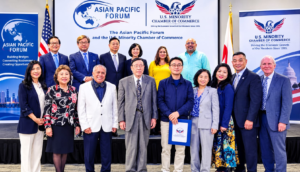
Our recent Economic Forum in Los Angeles, California, organized through the U.S. Minority Chamber of Commerce (USMCC), provided precisely that kind of extraordinary experience.
It was more than a business gathering. It was an opportunity to understand the remarkable economic influence of Asian-American communities and the different approaches they bring to entrepreneurship, investment, family businesses, and wealth creation.
My greatest discovery was simple: The Asian-American business community in Los Angeles is not one economy. It represents several distinct economic ecosystems, each with its own institutions, relationships, traditions, and business strategies.
And each offers important lessons for the future of minority entrepreneurship in the United States, particularly for our growing Hispanic business community.
THE CHINESE-AMERICAN BUSINESS COMMUNITY: TRUST BEFORE TRANSACTIONS
In communities such as San Gabriel Valley, Alhambra, and Monterey Park, I encountered an impressive concentration of Chinese-American entrepreneurship, investment activity, and commercial development.
One of my most important observations was that business relationships often begin with something more valuable than a contract: trust.
In many of the conversations I experienced, entrepreneurs wanted to understand the structure of our organization, the financial opportunities being presented, the credibility of our institutions, and the long-term value of a potential relationship.
A first meeting was not necessarily about closing a deal. It was about establishing confidence.
I also observed considerable attention to institutional independence and caution regarding political associations.
When we introduced ourselves as the U.S. Minority Chamber of Commerce, our institutional identity helped open conversations. The Chamber's mission, national reach, and commitment to minority business development provided a foundation for credibility.
The lesson: Institutional legitimacy opens doors, but trust, transparency, and consistent results keep those doors open.
THE FILIPINO-AMERICAN BUSINESS COMMUNITY: RELATIONSHIPS CREATE OPPORTUNITIES
Our engagement with Filipino-American entrepreneurs in areas such as Historic Filipinotown and Carson revealed another fascinating dimension of economic development.
I experienced a strong sense of community connection, family involvement, professional loyalty, and the importance of personal referrals.
Business relationships frequently extended beyond individual transactions. Community leaders, family networks, and trusted professional relationships played meaningful roles in connecting entrepreneurs with new opportunities.
What particularly impressed me was the enthusiasm surrounding the social and cultural dimensions of our Economic Forum.
Business networking, celebrations, recognition ceremonies, fashion, and community gatherings were not simply entertainment. They provided valuable settings where people could meet, establish confidence, introduce their businesses, and develop partnerships.
One influential community leader could help introduce our Chamber to an entire network of entrepreneurs.
The lesson: Business is not always conducted behind a desk. Sometimes the most valuable commercial relationships begin at a community reception, a gala dinner, or a cultural celebration.
This is a valuable principle for our Chamber as we continue developing economic forums and international business gatherings.
THE VIETNAMESE-AMERICAN BUSINESS COMMUNITY: ENTREPRENEURSHIP WITH A CLEAR PURPOSE
Our experience with Vietnamese-American entrepreneurs, particularly in Westminster and the internationally recognized Little Saigon business district of Orange County, offered another powerful perspective.
I encountered entrepreneurs with a strong focus on family businesses, operational discipline, competitive pricing, and measurable business opportunities.
During our conversations, I recognized the importance of presenting a clear commercial proposition.
What is the investment?
What is the expected return?
What is the business opportunity?
How long could it take to generate results?
These were the kinds of practical questions that shaped our discussions.
I was particularly impressed by the emphasis on entrepreneurship as a pathway toward family advancement and long-term financial independence.
Business education, financial literacy, market access, and the ability to understand commercial risks are essential elements of sustainable economic growth.
The lesson: Entrepreneurs do not need empty promises. They need access to markets, financial knowledge, credible partners, and a realistic pathway toward profitability.
I believe this is an especially important message for our Hispanic business community throughout the United States.
THE REAL CHALLENGE: CONNECTING ECONOMIC ECOSYSTEMS
One of the most significant conclusions from our Los Angeles experience is that successful engagement with diverse communities requires more than translating promotional materials into different languages.
It requires understanding how business relationships actually function.
Many established Asian-American commercial communities have developed their own networks of financial institutions, chambers of commerce, professional associations, lenders, investors, and trusted community leaders.
These institutions represent valuable economic infrastructure.
Our challenge at the U.S. Minority Chamber of Commerce is not to compete with these networks.
Our opportunity is to connect them.
We must build partnerships that respect their existing leadership while creating new opportunities through national procurement programs, international trade, investment, financing, business education, and corporate relationships.
An invitation delivered through a trusted community leader can carry greater influence than hundreds of promotional advertisements.
That is why our Chamber believes in direct engagement, institutional partnerships, and personal relationships.
We are not interested in simply attracting people to conferences.
We want to connect entrepreneurs with buyers, investors, contracts, capital, and opportunities that produce measurable economic results.
WHAT HISPANIC ENTREPRENEURS CAN LEARN
As a Hispanic business leader who has dedicated much of his professional life to strengthening minority entrepreneurship, I believe there are valuable lessons we can exchange with our Asian-American colleagues.
We must continue strengthening our own business institutions, encouraging family entrepreneurship, developing access to credit, supporting business education, and creating commercial networks that extend beyond our immediate communities.
We should also recognize that the Asian-American communities themselves are diverse. No single business model represents every Chinese, Filipino, or Vietnamese entrepreneur.
Nevertheless, the experiences and practices I observed demonstrate the value of long-term relationships, institutional credibility, financial discipline, and community cooperation.
For our Hispanic entrepreneurs, the message is particularly relevant:
Owning a business is an important beginning. Building an economic institution that creates opportunity for future generations is an even greater achievement.
Our Chamber's philosophy remains clear:
“WITHOUT ECONOMIC POWER, THERE IS NO VOICE.”
Economic participation creates opportunity. Business ownership builds assets. Strong institutions help communities expand their influence and participate more fully in America's prosperity.
This is the American Dream that unites entrepreneurs from Asia, Latin America, the Caribbean, and every corner of the United States.
FROM LOS ANGELES TO MIAMI: A NEW BUSINESS BRIDGE WITH ASIA
Our experience in Los Angeles has inspired a new initiative.
The U.S. Minority Chamber of Commerce is pleased to announce plans for a special international business forum during the:
26th Edition of CEO OF THE AMERICAS — MIAMI 2026
December 3–5, 2026
Sheraton Miami Airport Hotel | Miami, Florida
Special Forum: “HOW TO DO BUSINESS WITH ASIA THROUGH THE U.S. MINORITY CHAMBER OF COMMERCE”
As part of this initiative, we plan to invite 18 distinguished leaders representing Asian-American chambers of commerce and business organizations from Los Angeles, California, to participate in this international gathering.
Our objective is to establish a practical platform for commercial cooperation between Asian-American entrepreneurs, Hispanic-owned businesses, U.S. corporations, and business delegations from Latin America and the Caribbean.
The forum will focus on expanding business relationships, developing joint ventures, exploring import and export opportunities, attracting investment, strengthening access to procurement markets, and creating meaningful partnerships among minority business institutions.
More importantly, it will offer an opportunity for direct dialogue between business leaders who understand that economic cooperation can create prosperity across communities and international borders.
We want Asian-American businesses to see Miami as a gateway to Latin America and the Caribbean, while helping Hispanic entrepreneurs discover new opportunities through established Asian-American commercial networks.
This is not simply another conference.
It is part of our commitment to transforming relationships into contracts, conversations into investments, and institutional cooperation into long-term economic opportunities.
27 YEARS OF BUILDING BRIDGES AND CREATING OPPORTUNITIES
For 27 years, the U.S. Minority Chamber of Commerce has worked to strengthen the economic participation of minority entrepreneurs through business development, international cooperation, education, strategic relationships, and access to markets.
Our experience in Los Angeles reinforced a fundamental conviction:
America's diversity is not only a cultural treasure. It is one of the nation's greatest economic assets.
When Chinese-American, Filipino-American, Vietnamese-American, Hispanic-American, African-American, and other business communities work together, we create opportunities that extend far beyond the success of individual enterprises.
We contribute to stronger families, more competitive businesses, more prosperous communities, and a more dynamic American economy.
I leave Los Angeles with tremendous gratitude for the entrepreneurs, business leaders, and community representatives who shared their time, experiences, and perspectives with us.
You reminded me that the most powerful business relationships begin with respect, grow through trust, and succeed through action.
To our Asian-American business colleagues: Thank you for this extraordinary experience.
Our next chapter begins in Miami.
We look forward to welcoming you to CEO of the Americas Miami 2026, where we will continue building bridges between Asia, the United States, Latin America, and the Caribbean.
Together, we can transform diversity into opportunity, entrepreneurship into prosperity, and business relationships into a lasting economic legacy.